Last year at work my coworker Sue and myself took a two-hour break on a mid-September day to experience an amazing piece of natural history that's visible from many spots in Connecticut. This time of year is prime time for the migration of Broad-winged Hawks. These small Buteos breed all over the Northeast and begin a mass migration south every year at this time. Our hawk migration last year was great BUT we realized quickly we needed to spend more time watching for a real idea of what was flying over. So, this year we planned a full day to set up shop in the corner of a parking lot and count some hawks. Luckily, the weather conditions leading up to the day and the day itself was perfect for Broad-winged Hawk migration. Check out the results here.
http://www.birdingwestcampus.blogspot.com/
 |
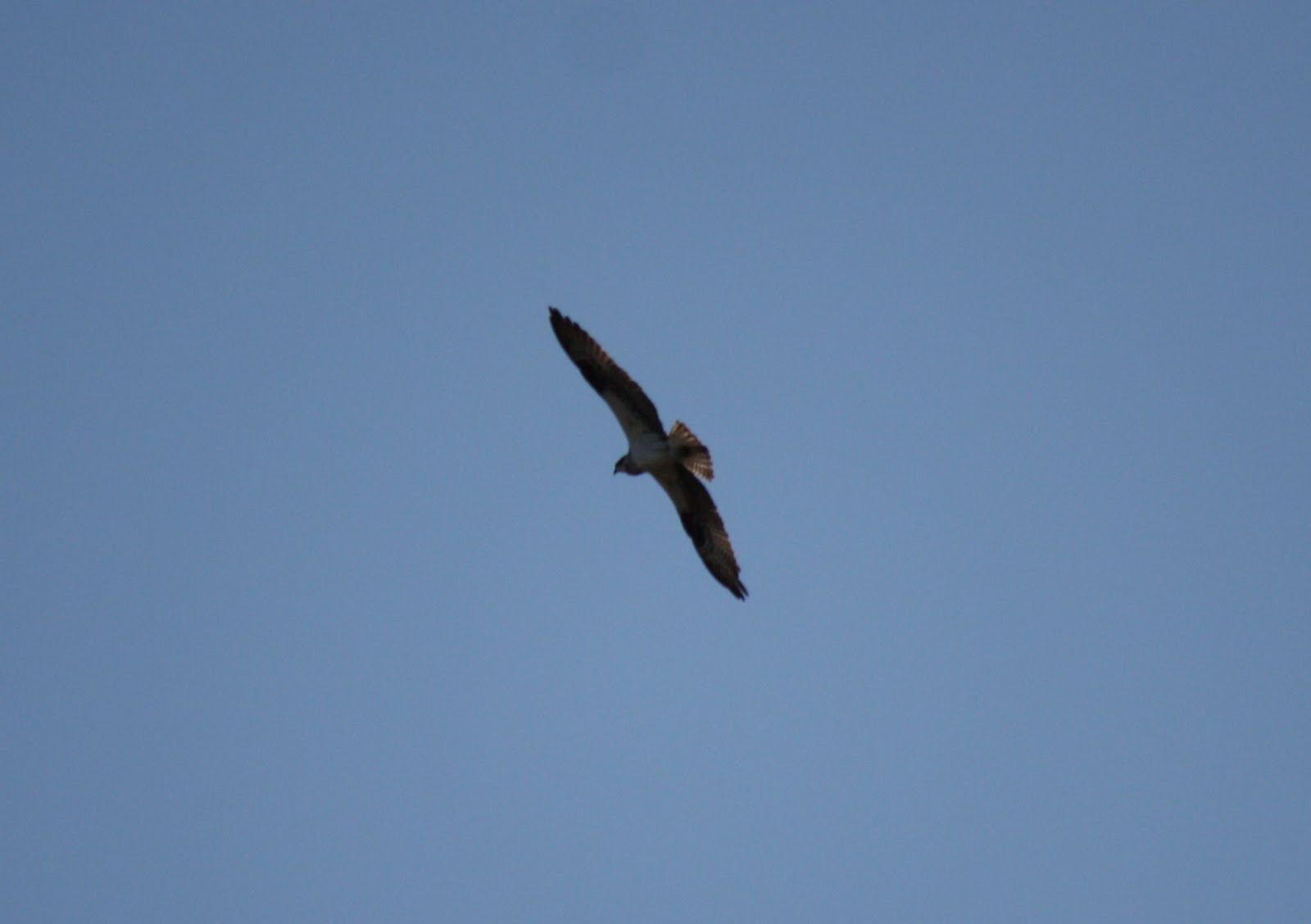
| Osprey: un-modified |
For anyone who hasn't taken part in a hawkwatch, I wanted to give an idea of what hawkwatchers are looking at and how one goes about identifying the dots. The first thing to do is prepare for a neck-ache. We took out plastic Adirondack chairs that were slightly reclined so we could keep our eyes to the sky without having to get too sore. But as soon as we see a hawk it's time to jump up quick and get ready to follow it with your binoculars. It's not an easy task to identify a bird that can be thousands of feet above you. The first step is to identify the silhouette of the bird.
 |
| Osprey: lightened to show plumage |
This Osprey has a very distinctive shape with very long wings in relation to the body length. The wings are also fairly narrow and have a bend along the leading edge. Osprey that are fairly close are also easy to distinguish with their strong contrasting plumage of light and dark. Two other groups of raptors that are common at this time of year are the Accipiters and falcons. These two groups are similar in size and both have long narrow tails but the Accipiters have broader wings with the back edge usually curved. The falcons have pointed wings and the trailing edge of the wing is fairly straight. Accipiters also fly by doing a few quick wing beats and then a quick soar. Falcons tend to flap their wings for longer periods of time before gliding across the sky.
 |
| Red-tailed Hawk |
 |
| Red-tailed Hawk: ventral view showing belly band |
The group of hawks known as Buteos, like the Red-tailed Hawk above, tend to have fairly bulky wings and shorter tails. They also have a bulky body appearance. Often there are easy clues in the color of the plumage to identify the species. Red-tailed Hawks are mostly pale below with a darker band across the belly and also a dark spot in the middle of the leading edge of the wing. Red-shouldered Hawks on the other hand are identified by locating two pale crescents at the ends of the wings.
 |
| Kettle of Hawks |
Here's what we really see though when counting hawks such as these Broad-winged Hawks that migrate at this time of year in huge numbers. We look at behavior in most cases to get an identification of birds at this distance. When there are that many hawks and they are all flying together and behaving similarly at this time of year, you can pretty much make an identification that they are Broadies. But when we can get a little closer by looking through binoculars you start to pick up more features.
 |
| Broad-winged Hawk kettle |
Now we can see that they are all about the same size. They all have similar silhouettes and are flying in the same manner. While it's easy to count when the birds are streaming, going over in one long stream of birds, it gets more difficult when they form these kettles where they are trying to use the thermals to gain altitude again.
 |
| Broad-winged Hawks |
Finally, When we get a better look at a few closer up we can see that they are mostly white underneath with black fingertips on the wings and the trailing edge of the wing also has a black line. Notice the strongly zoned tail with equal amounts of black and white. Both of the birds above are Broad-winged Hawks, sometimes size is difficult to judge depending on how high up birds are and also, every species has variation in the size of individuals. That's why as a hawkwatcher you have to look at a bunch of smaller characteristics to be able to finally make an identification.
In the end, all of our work was well worth it. We had a great day outside and saw quite a few different species. And it's great to hear people react... "You saw that many hawks, here?", when we tell them we saw over 1800 raptors in one day.