Showing posts with label West Campus. Show all posts

Thursday, November 15, 2012

Gotta Keep Up

The title of this blog may have you thinking, I'm referring to blog entries or keeping the feeders full or even my species count for my competition.  I wish it was in reference to the fun side of birding, the happy days of searching new species or of simply enjoying the ones I share my yard with and then share with my readers.  Today, I walked out into the courtyard at work and found a horde of birds that were casualties of circumstance.  These birds had simply picked the wrong place to forage and never saw the glass that they flew into. 

 
American Robins from the beginning of Nov.


I can't even count the number of dead or injured birds we have found around work that were victims of window strikes.   If I were to estimate over the last 4 years...  I'd guess around 300.  What amazes me is not the number but the fact that those are only the ones I've seen.  When I think of all the other building in the world and all the other windows, the estimates conservationist make seem beyond real and more like an understatement. 

Fox Sparrow, not all the birds die, at least right away.


Here the abundance of window strikes is without a doubt Dark-eyed Juncos.  These small gray-brown sparrows breed across Canada and into the northern US, including some higher altitude areas farther south.  During the winter they migrate south as far as parts of Mexico to forage for food and survive before heading north again.  There are quite a number of forms of Dark-eyed Junco as would be expected from the large distribution of the species.  To go into any more details about their behavior would require discussing separate forms.  Instead, I just also mention that they are NOT the only birds that have been killed.

Dark-eyed Junco (Junco hyemalis)- 10 in total today from one hall

Window Strike Species (off the top of my head): Red-tailed Hawk, Sharp-shinned Hawk, Cooper's Hawk, Mourning Dove, Hermit Thrush, Swainson's Thrush, Ruby-crowned Kinglet, Golden-crowned Kinglet, Ruby-throated Hummingbird, Dark-eyed Junco, White-throated Sparrow, Song Sparrow, Fox Sparrow, Northern Flicker, American Robin, Yellow-rumped Warbler, Black-throated Green Warbler, Common Yellowthroat, Chestnut-sided Warbler, Northern Waterthrush, Indigo Bunting, Brown Creeper, etc, etc.


Squirt Bottle
filled with soapy water
So back to the title.  I take some of the blame for today's casualties.  We have tried a number of different methods for keeping them from flying into the windows but our options are limited because it is a workplace.  In vacant areas we've put some newspaper up on the windows but that's not an option for the higher traffic sections.  In those areas we try to do non-invasive window soaping.  The basic goal is get soap scum on the windows to breakup the reflection and let the birds know something is there.  BUT I haven't done it in awhile and with all the rain, most of the residue has washed away.  I "Gotta Keep Up" with making sure we're making an effort to reduce the number of window strikes. 


Me illustrating the final product, it doesn't stop the strikes
but it does reduce them.

Friday, October 12, 2012

Fall FALL Migration!

I LOVE fall migration and this year is a great one.  This week at work we've had our second all time high for bird species on campus.  That's beating out three spring migration seasons, pretty impressive.  So why is fall migration my favorite (recently decided)?  The weather is nice, the birds are plentiful, and the species hint at how busy feeders will be in a few months.  One of the best parts is how tricky the birds are, leaves on trees obscure views, species are in nonbreeding plummage and those tricky sparrows that have been gone for months suddenly arrive and id's need refreshing.

Clay-colored Sparrow
 
Anyway, recently I've been hawk watching and enjoying the sparrows as they file back into the weedy grassy sections of lawns.  Rather than talk about species and birding adventures, here's a few photos.  As for how my competition is going... I'm not sure.  I'm doing ok but I don't know how the Oregon list is going. 


Northern Harrier- (young bird)

Palm Warbler- Yellow (Eastern)

Palm Warbler- Brown (Western)

Black-throated Blue Warbler

Could it be a Lincoln's Sparrow??

Nope, It's a Swamp Sparrow

Black Scoter (female) *LIFE BIRD*
 

Friday, September 21, 2012

Birdy Corner = Great Bird

On Wednesday while driving onto campus I was running a little later than usual and was planning on just heading straight up to my building without taking my usual diversion around grounds.  One corner of one of the parking lots is an edge habitat and lawn, we refer to it as the "Sparrow Nook".  I noticed some decent activity, a migrating flock of American Robins, congregating Brown-headed Cowbirds with European Starlings mixed in, and a few Blue Jays poking around as well.  The activity was too much to just drive by.


I noticed something sparrowy and once I had binoculars out was fairly perplexed...  yes it was a sparrow but one that I hadn't seen before.  With no camera and no field guide, I tried to pick out all the features I could and headed up to my building to do some quick internet research.  I couldn't quite pin down the species before my coworker came in and I tried giving her details that maybe she could ID.  Finally, I just dragged us both out there with a point and shoot camera with a 20x optical zoom. 


We had come up with a tentative ID of Lark Sparrow and with some more internet research it was confirmed.  Sue (my coworker) will probably blog some info about the species on our work blog HERE.  The quick story is that Lark Sparrows are vagrants in Connecticut and only a couple show up in CT every year if that.  Oh and it was a LIFE BIRD for me.  Enjoy the grainy photos!


Tuesday, August 21, 2012

A Little Movement

A little cheating post here since I don't have time or inclination to go find any pictures...  Ok maybe I'll put one in.  Anyway, I promise I'll get a few pics up from my trip although over all it was pretty unbirdy.  BUT it's the start of Hawk Watch season here in CT and I am super excited.  I went out to my secret lunch spot today, binoculars at the ready, and had our first nice little push of raptors.  In about 10 minutes there were around 3 Red-tailed Hawks (besides our 2 resident birds also out), at least 1 Red-shouldered Hawk, 3 Osprey, and 1 Sharp-shinned Hawk.  It got pretty quiet after that, more Red-tailed action but probably just our local two. 

Speaking of our local birds.... they could use a good molt.  Both birds are missing numerous feathers and look pretty ratty. 

Here's an old picture of an Osprey.

Tuesday, October 4, 2011

Window Strikes Again

Almost every morning that I drive into campus, I make a swing under what I have started to call the 'corridor of doom'.  It's not 1 but 2 floors of elevated glass hallway that connect two buildings here at work.  I guess I should clarify, two unoccupied buildings here at work.  I've asked if they would be willing to lower the shades all the time, at least until people move in.  Of course, the answer is that it is an impossibility because it's automatically programmed to close and open based on temperature in the blah blah blah.  I must admit to me it sounds like, the hallway is too pretty to keep shaded and I'm not going to put the trouble into figuring out how to do it. 

Casualties of the Corridor of Doom: Ruby-throated Hummingbird and Black-throated Green Warbler


One fall we had a HUGE fallout of Juncos and unfortunately many did not survive.  Luckily, that has been by far the worst accrual of death we have had due to window strikes.  I can't blame all the death on those corridors however; our building also has three ground-floor passageways with glass on both sides.  One side of one passageway causes most of the window strikes in our building and we've been lucky that we have gotten away with hanging newspaper on the windows and no one has taken it down.  Lucky except... there's a glass door with a glass header over it and the birds still fly into that. 

Last week I went out for a quick walk-through the courtyard and didn't see anything by the windows and was happily enjoying the White-throated Sparrows that have just shown up on campus, the American Robins feasting on random berries, and a Common Yellowthroat hopping around in the underbrush. 

Then as I was heading in the doors, here was this little bird sitting on the cold cement slab panting.  Ruby-throated Humingbirds are still migrating through Connecticut with mostly females and first year birds left.  Most of the hawkwatch sites count the Ruby-throats they see and by this time the numbers are starting to drop off with most of the birds already reaching the southern U.S. on their way to Mexico and South America to overwinter. 


Ruby-throated Hummingbird- female/ immature type

So why did I pick this bird up and not just leave it where it was to recover?  Hummingbirds burn a lot of energy and they have a very small body which doesn't retain heat very well.  I picked it up to donate some of my body heat while the bird was recovering.  After a few minutes of sitting on my open palm, it recovered enough to fly up to a tree branch in the sun about 15 feet above me.  I watched it for about five minutes but it was still sitting in the tree when I left, I figured it could probably do without the stress of having me still so close. 

Ruby-throated Hummingbird- recovering from window strike

Sunday, September 25, 2011

Birds and Vegetables

After reading a post on the CT bird listserv I headed over to the Stratford Community Garden to look for a bird that I had never seen before.  A Dickcissel is a House Sparrow-sized bird that breeds throughout the Midwest and winters in Central America.  Every now and then a few birds get turned around and head east instead.  A local Stratford birder had reported two at the community garden and I was lucky enough to find one!  A life bird!

Dickcissel

Another great bird that was stopping by the garden was two Bobolinks.  Bobolinks are normal migrants through our area but they aren't as often seen as heard.  That's why I was excited to see these two.

Bobolink

Bobolink- notice the sharp tail feathers

One last little surprise was a Marsh Wren who was pretty elusive.  I heard a few short chip call notes and saw it hop up and down on some fencing but it never really came out into good view.  This was the best shot I got.... pretty sad.

Marsh Wren

I had another great day today in the birding world.  I joined the Sunrise Birding group led by Luke Tiller on a warbler walk and we were successful!  The best part of this trip was the first fifteen minutes when we found a little group of warblers, two of which were life birds for me!  Both a Prairie Warbler and a Blackpoll Warbler were part of the group!  Not that they are unusual or even uncommon warblers, it just shows how much time I haven't put in to birding during migration.  No pictures this time but I'm sure now that I have seen them, they will show up everywhere.  Case in point, first great looks at a Wilson's Warbler (not a super common bird) was this week at work, my first CT sighting in fact and today we had two Wilson's Warblers in full view on our walk.  Oh Birds!

Tuesday, September 20, 2011

Yes That Many Hawks!

Last year at work my coworker Sue and myself took a two-hour break on a mid-September day to experience an amazing piece of natural history that's visible from many spots in Connecticut.  This time of year is prime time for the migration of Broad-winged Hawks.  These small Buteos breed all over the Northeast and begin a mass migration south every year at this time.  Our hawk migration last year was great BUT we realized quickly we needed to spend more time watching for a real idea of what was flying over.  So, this year we planned a full day to set up shop in the corner of a parking lot and count some hawks.  Luckily, the weather conditions leading up to the day and the day itself was perfect for Broad-winged Hawk migration.  Check out the results here.  http://www.birdingwestcampus.blogspot.com/


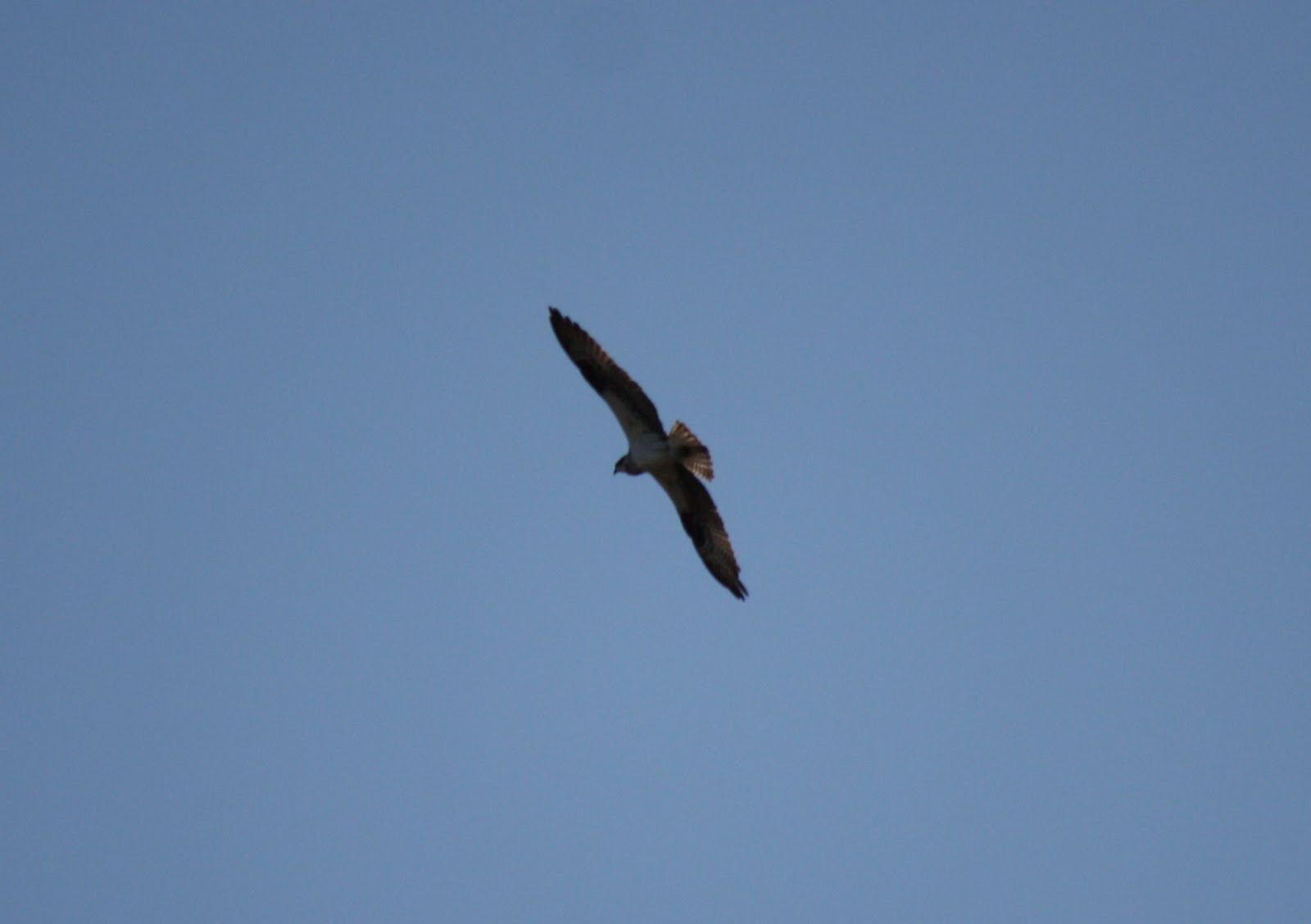
Osprey: un-modified


For anyone who hasn't taken part in a hawkwatch, I wanted to give an idea of what hawkwatchers are looking at and how one goes about identifying the dots.  The first thing to do is prepare for a neck-ache.  We took out plastic Adirondack chairs that were slightly reclined so we could keep our eyes to the sky without having to get too sore.  But as soon as we see a hawk it's time to jump up quick and get ready to follow it with your binoculars.  It's not an easy task to identify a bird that can be thousands of feet above you.  The first step is to identify the silhouette of the bird.


Osprey: lightened to show plumage

This Osprey has a very distinctive shape with very long wings in relation to the body length. The wings are also fairly narrow and have a bend along the leading edge.  Osprey that are fairly close are also easy to distinguish with their strong contrasting plumage of light and dark.  Two other groups of raptors that are common at this time of year are the Accipiters and falcons.  These two groups are similar in size and both have long narrow tails but the Accipiters have broader wings with the back edge usually curved.  The falcons have pointed wings and the trailing edge of the wing is fairly straight.  Accipiters also fly by doing a few quick wing beats and then a quick soar.  Falcons tend to flap their wings for longer periods of time before gliding across the sky. 


Red-tailed Hawk

Red-tailed Hawk: ventral view showing belly band

The group of hawks known as Buteos, like the Red-tailed Hawk above, tend to have fairly bulky wings and shorter tails.  They also have a bulky body appearance.  Often there are easy clues in the color of the plumage to identify the species.  Red-tailed Hawks are mostly pale below with a darker band across the belly and also a dark spot in the middle of the leading edge of the wing.  Red-shouldered Hawks on the other hand are identified by locating two pale crescents at the ends of the wings.

Kettle of Hawks

Here's what we really see though when counting hawks such as these Broad-winged Hawks that migrate at this time of year in huge numbers.  We look at behavior in most cases to get an identification of birds at this distance.  When there are that many hawks and they are all flying together and behaving similarly at this time of year, you can pretty much make an identification that they are Broadies.  But when we can get a little closer by looking through binoculars you start to pick up more features.


Broad-winged Hawk kettle

Now we can see that they are all about the same size.  They all have similar silhouettes and are flying in the same manner.  While it's easy to count when the birds are streaming, going over in one long stream of birds, it gets more difficult when they form these kettles where they are trying to use the thermals to gain altitude again. 

Broad-winged Hawks
 Finally, When we get a better look at a few closer up we can see that they are mostly white underneath with black fingertips on the wings and the trailing edge of the wing also has a black line.  Notice the strongly zoned tail with equal amounts of black and white.  Both of the birds above are Broad-winged Hawks, sometimes size is difficult to judge depending on how high up birds are and also, every species has variation in the size of individuals.  That's why as a hawkwatcher you have to look at a bunch of smaller characteristics to be able to finally make an identification.

In the end, all of our work was well worth it.  We had a great day outside and saw quite a few different species.  And it's great to hear people react... "You saw that many hawks, here?", when we tell them we saw over 1800 raptors in one day.

Tuesday, April 12, 2011

The Littlest Falcon

Three different species of falcon call Connecticut home, Peregrine Falcon, Merlin, and American Kestrel.  The American Kestrel, the smallest of the three falcon species, is an open prairie or grassland hunter in general, feeding on almost any small moving animal.  They are known best for their love of grasshoppers and dragonflies as food for their young.  Unfortunately, this habitat is becoming compressed in the state and compounding that with a reduction in nesting spots, the population of nesting kestrels has dropped.  Recent efforts by bird lovers such as Art Gingert and Tom Sayers have helped these falcons bounce back, if even just a little.

Now for my story:  Yale's West Campus is approximately 130 acres, many of it wooded, but the majority is landscapes lawns and some natural grassy areas.  We have been working to encourage the landscapers to retain as much 'natural' habitat as possible in hopes that it will attract more bird species.  Our current species count on campus is at over 100 and American Kestrel is one of those we have seen on frequent occasions.  So, it didn't take long for us to begin to wonder if maybe a kestrel would want to use campus to raise their young. 

Sue (my coworker) and I decided to try and get a nest box to hang in one of these natural grassy areas.  We made contact with Art Gingert who supplies nest boxes in suitable habitat but he felt ours was not good enough quality to be able to give us a box, when other better habitat was in need.  We however, have a tough time giving up so easy and instead dug into our pockets and pulled together enough money to buy the supplies to build our own box.

After months of delay (it was winter anyway), we volunteered Nate another coworker to help us put together the box.  After about 7 months of the wood sitting around, two weeks was all it took to get the box together and ready to hang.  Last Wednesday was a nice sunny day, we had some spare time, and a nest box ready to hang.  Here are a series of pictures from the afternoon.


Lynn (Me) showing off the finished product


Hanging the kestrel nest box about 12' from the ground.


Nate doing some final touches

If you have an interest in learning more about American Kestrel, information can be hard to find, I'd suggest starting here

Information about Tom Sayers work in CT can be found here.

Directions from Art Gingert on how to build a nest box can be found here

We are keeping our eyes on the box and around campus in general for kestrels.  I'll keep you posted with any updates.