Wednesday, February 22, 2012

End of the Road

After a meeting in downtown New Haven, I headed back to the Peabody Museum to have yet another meeting.  I pulled into the parking lot next to the Peabody at the end of Humphrey and came to the stop sign in the parking lot.  Looking up on the small grassy patch across the way, I suddenly yelled.  "Oh My God!  It's a Peregrine Falcon eating a Pigeon."

Peregrine Falcon- feather from prey

Sure enough an adult Peregrine Falcon was sitting on top of it's prey pulling off little bits and pieces.  We quietly (we were in a hybrid) pulled up next to the bird and pulled out our cell phones.  Pictures aren't 'the best' but the view certainly was. 

Someone is coming...

I sent the picture over to Steve Broker who has been studying some of the local Peregrine Falcons and found out that a pair has nested on both East Rock and West Rock.  He has also noticed some activity associated with the Klein Biology Tower (KBT) in the science hill area of Yale's campus.  This shot was almost at the foot of that building and very likely might be a pair of birds scoping out the tower for a nesting spot. 

Peregrine Falcon taking a bite.

It's amazing what a few trees in a parking lot can produce.  I've seen Common Grackles nesting in the parking lot, Chipping Sparrows throughout the summer, warbler species use them as a stop during migration, there's been Red-tailed Hawks mating in the branches, Common Ravens visit the museum, and now a Peregrine Falcon stopping for a bite to eat. 

Common Raven (image taken on Yale West Campus)

Sunday, January 22, 2012

Slow Going

Hairy Woodpecker- male
It's not that I hate the cold...  I just don't like it.  Instead of hitting all those great little spots that I see posted about or finding some of the rarities, like the Harris's Sparrow that have been seen in Connecticut, I've been hiding out inside in the warm.  I haven't even been taking the normal quick walks around work, instead I've been hiding in the gym working out. 


Hairy Woodpecker- showing off
With the snow yesterday, I headed out this morning to clean off the sidewalks.  After a few eerily quiet minutes a Hairy Woodpecker called and called and called.... finally after about 15 minutes it worked it's way over to the suet to feed for a few minutes.  A neighbor suddenly came outside spooking the Hairy back up into the tree.  Where it called, and called, and called some more.  Then, it flew off making a noise I had never heard before.


Then, I heard a a Hairy Woodpecker call in the same tree the other one had flown out out of.  Sure enough another woodpecker was up in the tree.  It was a male and the other one had been a female.  Pretty exciting that in my practically urban neighborhood is a pair of Hairy Woodpeckers.  Anyway, it was a first of the year for me.  My CT total is only up to about 55 species.  I guess I need to get outside next weekend!
Showing off his red.

Sunday, January 8, 2012

A CT Big Year

Ring-billed Gull- Birdseye Boat Ramp, Stratford
For a little extra birding motivation, I challenged a friend to see who could get the most species of bird in a year of birding in the state.  My state, Connecticut and her state...  Oregon!  Looking over the last three years of eBird records, Oregon has consistently had about 50 more species recorded than Connecticut.  So, She has the advantage.  I'm not too worried though because within a couple of hours I can chase down almost any bird in my state.  (If I actually do it).  Making it across Oregon to chase a bird takes a little more effort and planning.


Canada Goose- Wooster Park, Stratford (partially leucistic)
Yellow-bellied Sapsucker- Brewster Pond, Stratford


So, after a week of only incidental birding, I got out this weekend and found some birds!  Saturday I spent a few hours hitting up some town spots.  Today I went out and chased some rarities. The first bird I targeted was the Yellow-throated Warbler seen in Madison, CT that has been visiting a feeder since October.  The bird was there when I got out of the car and I got my bins on it.  About 30 minutes later it came back grabbed some  suet and headed off again.

Canvasback- Frash Pond, Stratford (verification picture)


Sanderling- Long Beach, Stratford

I also made the haul up to the Enfield/ Somers area to chase the Pink-footed Goose.  This species usually spends its' winters in northern Europe.  Apparently, at least one goose got turned around and headed here instead.  I finally saw it after spending 2 hours driving around 3 towns.  Thanks to yet another very nice birder, I looked through his scope and saw a very distant view.  I'd like to thank the Canada Goose for moving out of the way right before the Pink-footed Goose wandered behind the reeds.  No photo but maybe here's a link to someone elses blog who saw it earlier in the week.  Yay Life Bird!!!


Yellow-throated Warbler- Madison

OOOOhhhh yeah, In case you were wondering...  I'm up to about 53 species.

Saturday, October 15, 2011

The Big Year: A Birders Review

When I compare the efforts and obsession of the characters depicted in the movie The Big Year and I think of my own efforts, I almost hesitate in calling myself a birder.  The movie was based on a book and the the book was written by one of the birders depicted in the movie.  I must admit that is the extent on my knowledge of the background of the movie but I was still looking forward to it with anticipation.  I even went to see the movie on opening night, something I'm not sure I've ever done before.

What is a "Big Year"?  In the world of those slightly obsessive bird watchers, called birders, there is an unofficial challenge some attempt, to see the most bird species possible in North America during one calendar year.  The movie follows the story of three men who are attempting a Big Year and meet at various bird sightings.  It delves into the world of birding while also keeping a human story line by showing the personal lives of each and how the Big Year attempt impacts those relationships.

I like it!   I really like it!  I went in assuming I would hate it, an entire movie, a comedy, devoted to making fun of something I have such a passion for.  The truth is, I'm not sure I would like it so much if I weren't a birder.  I admit that birding isn't the most alluring hobby for most, although it's not stamp collecting or anything.  The movie actually gives the world a glimpse into birdwatching without ridicule (well maybe a little), and is relatively entertaining.

I giggled at many points in the movie, most of the time over birder-esque things.  I think there could have been a little more slapstick comedy in it.  I mean we've all had some falls while hiking through the woods or been so focused on finding THAT bird that we've stepped in something unpleasant.  And while there were a few of those moments, mostly by Jack Black's character,  I think there could have even been more.  I mean seriously.... no one even got pooped on. 

The non-birding guy I went with said that he enjoyed it... but I think the thing he laughed at the most was when we got out of the movie and the first thing I did was to check my phone and the CT Bird Listserv to see if anyone had reported anything interesting.  Yeah, I think I'll laugh a little more at myself too.

Tuesday, October 4, 2011

Window Strikes Again

Almost every morning that I drive into campus, I make a swing under what I have started to call the 'corridor of doom'.  It's not 1 but 2 floors of elevated glass hallway that connect two buildings here at work.  I guess I should clarify, two unoccupied buildings here at work.  I've asked if they would be willing to lower the shades all the time, at least until people move in.  Of course, the answer is that it is an impossibility because it's automatically programmed to close and open based on temperature in the blah blah blah.  I must admit to me it sounds like, the hallway is too pretty to keep shaded and I'm not going to put the trouble into figuring out how to do it. 

Casualties of the Corridor of Doom: Ruby-throated Hummingbird and Black-throated Green Warbler


One fall we had a HUGE fallout of Juncos and unfortunately many did not survive.  Luckily, that has been by far the worst accrual of death we have had due to window strikes.  I can't blame all the death on those corridors however; our building also has three ground-floor passageways with glass on both sides.  One side of one passageway causes most of the window strikes in our building and we've been lucky that we have gotten away with hanging newspaper on the windows and no one has taken it down.  Lucky except... there's a glass door with a glass header over it and the birds still fly into that. 

Last week I went out for a quick walk-through the courtyard and didn't see anything by the windows and was happily enjoying the White-throated Sparrows that have just shown up on campus, the American Robins feasting on random berries, and a Common Yellowthroat hopping around in the underbrush. 

Then as I was heading in the doors, here was this little bird sitting on the cold cement slab panting.  Ruby-throated Humingbirds are still migrating through Connecticut with mostly females and first year birds left.  Most of the hawkwatch sites count the Ruby-throats they see and by this time the numbers are starting to drop off with most of the birds already reaching the southern U.S. on their way to Mexico and South America to overwinter. 


Ruby-throated Hummingbird- female/ immature type

So why did I pick this bird up and not just leave it where it was to recover?  Hummingbirds burn a lot of energy and they have a very small body which doesn't retain heat very well.  I picked it up to donate some of my body heat while the bird was recovering.  After a few minutes of sitting on my open palm, it recovered enough to fly up to a tree branch in the sun about 15 feet above me.  I watched it for about five minutes but it was still sitting in the tree when I left, I figured it could probably do without the stress of having me still so close. 

Ruby-throated Hummingbird- recovering from window strike

Sunday, September 25, 2011

Birds and Vegetables

After reading a post on the CT bird listserv I headed over to the Stratford Community Garden to look for a bird that I had never seen before.  A Dickcissel is a House Sparrow-sized bird that breeds throughout the Midwest and winters in Central America.  Every now and then a few birds get turned around and head east instead.  A local Stratford birder had reported two at the community garden and I was lucky enough to find one!  A life bird!

Dickcissel

Another great bird that was stopping by the garden was two Bobolinks.  Bobolinks are normal migrants through our area but they aren't as often seen as heard.  That's why I was excited to see these two.

Bobolink

Bobolink- notice the sharp tail feathers

One last little surprise was a Marsh Wren who was pretty elusive.  I heard a few short chip call notes and saw it hop up and down on some fencing but it never really came out into good view.  This was the best shot I got.... pretty sad.

Marsh Wren

I had another great day today in the birding world.  I joined the Sunrise Birding group led by Luke Tiller on a warbler walk and we were successful!  The best part of this trip was the first fifteen minutes when we found a little group of warblers, two of which were life birds for me!  Both a Prairie Warbler and a Blackpoll Warbler were part of the group!  Not that they are unusual or even uncommon warblers, it just shows how much time I haven't put in to birding during migration.  No pictures this time but I'm sure now that I have seen them, they will show up everywhere.  Case in point, first great looks at a Wilson's Warbler (not a super common bird) was this week at work, my first CT sighting in fact and today we had two Wilson's Warblers in full view on our walk.  Oh Birds!

Tuesday, September 20, 2011

Yes That Many Hawks!

Last year at work my coworker Sue and myself took a two-hour break on a mid-September day to experience an amazing piece of natural history that's visible from many spots in Connecticut.  This time of year is prime time for the migration of Broad-winged Hawks.  These small Buteos breed all over the Northeast and begin a mass migration south every year at this time.  Our hawk migration last year was great BUT we realized quickly we needed to spend more time watching for a real idea of what was flying over.  So, this year we planned a full day to set up shop in the corner of a parking lot and count some hawks.  Luckily, the weather conditions leading up to the day and the day itself was perfect for Broad-winged Hawk migration.  Check out the results here.  http://www.birdingwestcampus.blogspot.com/


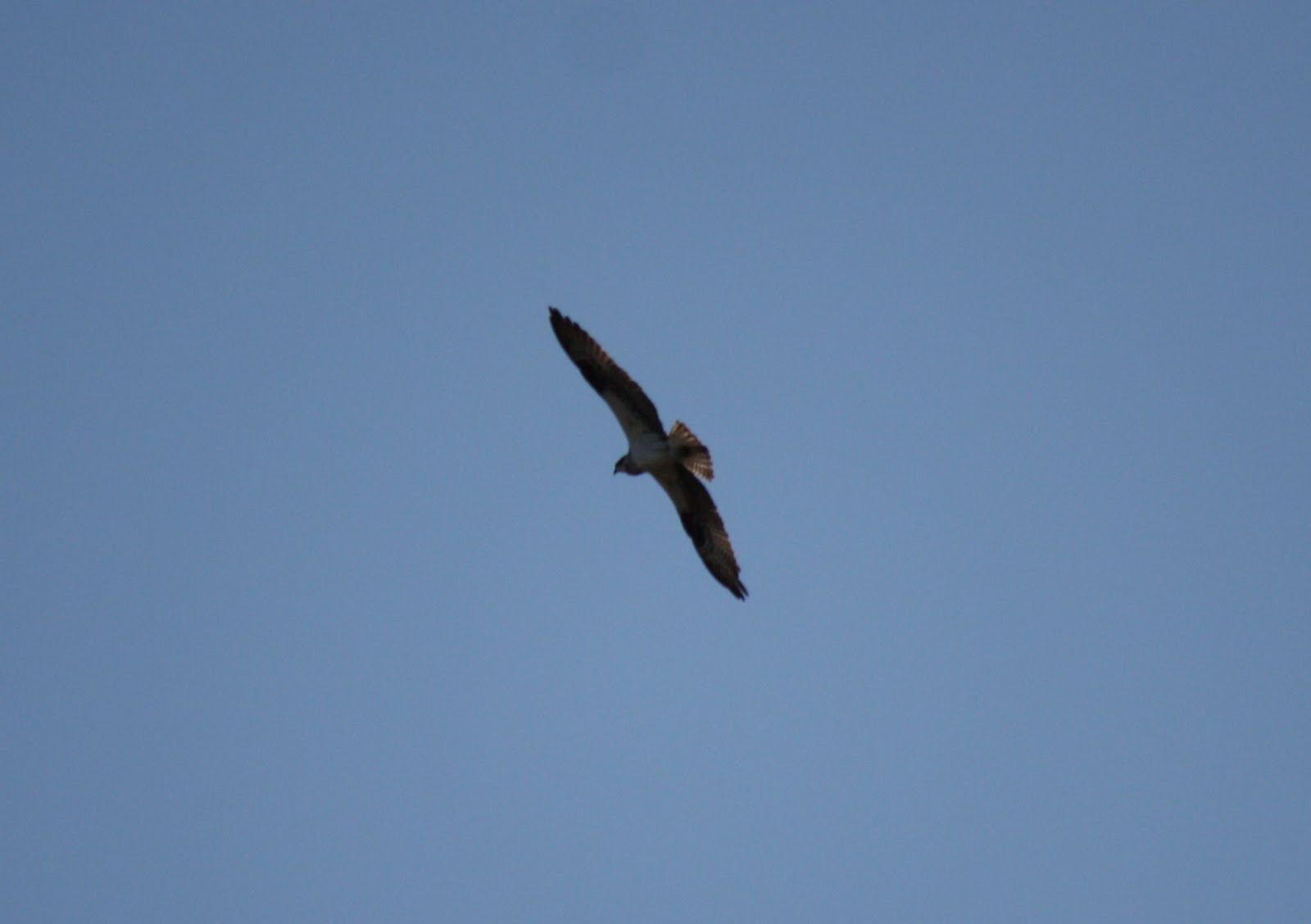
Osprey: un-modified


For anyone who hasn't taken part in a hawkwatch, I wanted to give an idea of what hawkwatchers are looking at and how one goes about identifying the dots.  The first thing to do is prepare for a neck-ache.  We took out plastic Adirondack chairs that were slightly reclined so we could keep our eyes to the sky without having to get too sore.  But as soon as we see a hawk it's time to jump up quick and get ready to follow it with your binoculars.  It's not an easy task to identify a bird that can be thousands of feet above you.  The first step is to identify the silhouette of the bird.


Osprey: lightened to show plumage

This Osprey has a very distinctive shape with very long wings in relation to the body length. The wings are also fairly narrow and have a bend along the leading edge.  Osprey that are fairly close are also easy to distinguish with their strong contrasting plumage of light and dark.  Two other groups of raptors that are common at this time of year are the Accipiters and falcons.  These two groups are similar in size and both have long narrow tails but the Accipiters have broader wings with the back edge usually curved.  The falcons have pointed wings and the trailing edge of the wing is fairly straight.  Accipiters also fly by doing a few quick wing beats and then a quick soar.  Falcons tend to flap their wings for longer periods of time before gliding across the sky. 


Red-tailed Hawk

Red-tailed Hawk: ventral view showing belly band

The group of hawks known as Buteos, like the Red-tailed Hawk above, tend to have fairly bulky wings and shorter tails.  They also have a bulky body appearance.  Often there are easy clues in the color of the plumage to identify the species.  Red-tailed Hawks are mostly pale below with a darker band across the belly and also a dark spot in the middle of the leading edge of the wing.  Red-shouldered Hawks on the other hand are identified by locating two pale crescents at the ends of the wings.

Kettle of Hawks

Here's what we really see though when counting hawks such as these Broad-winged Hawks that migrate at this time of year in huge numbers.  We look at behavior in most cases to get an identification of birds at this distance.  When there are that many hawks and they are all flying together and behaving similarly at this time of year, you can pretty much make an identification that they are Broadies.  But when we can get a little closer by looking through binoculars you start to pick up more features.


Broad-winged Hawk kettle

Now we can see that they are all about the same size.  They all have similar silhouettes and are flying in the same manner.  While it's easy to count when the birds are streaming, going over in one long stream of birds, it gets more difficult when they form these kettles where they are trying to use the thermals to gain altitude again. 

Broad-winged Hawks
 Finally, When we get a better look at a few closer up we can see that they are mostly white underneath with black fingertips on the wings and the trailing edge of the wing also has a black line.  Notice the strongly zoned tail with equal amounts of black and white.  Both of the birds above are Broad-winged Hawks, sometimes size is difficult to judge depending on how high up birds are and also, every species has variation in the size of individuals.  That's why as a hawkwatcher you have to look at a bunch of smaller characteristics to be able to finally make an identification.

In the end, all of our work was well worth it.  We had a great day outside and saw quite a few different species.  And it's great to hear people react... "You saw that many hawks, here?", when we tell them we saw over 1800 raptors in one day.